5 Common Causes of Inverter Failure and How to Extend Its Service Life
Last updated: 4 Nov 2026
27 Views
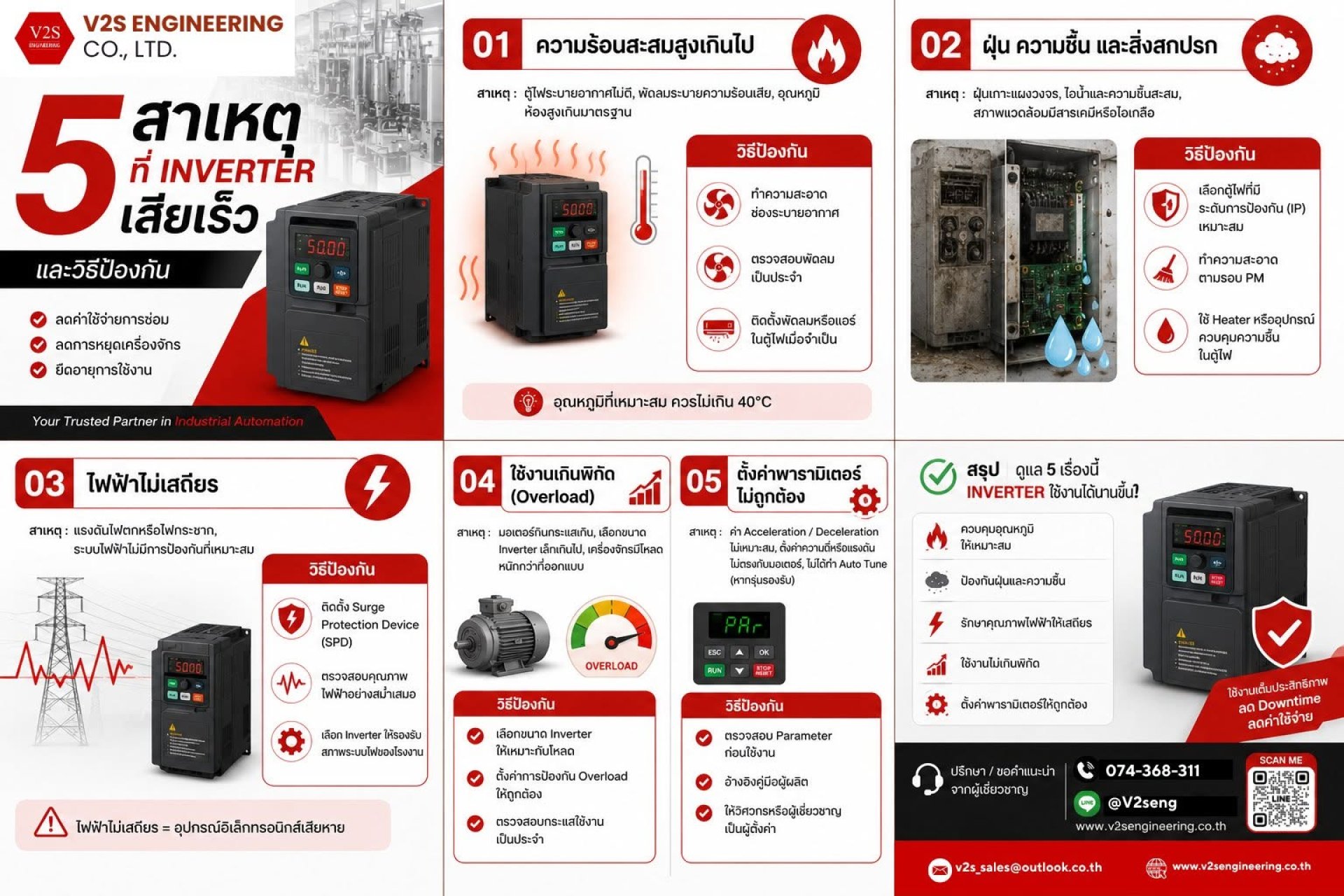
An inverter, also known as a Variable Speed Drive (VSD), is an essential component in industrial motor control systems. It regulates motor speed and torque according to application requirements, helping improve machine performance and support energy efficiency.
However, frequent inverter failures can interrupt production processes, increase maintenance expenses, and affect overall factory productivity.
In many cases, inverter failures are not caused by the equipment itself. Environmental conditions, installation practices, and improper operation can also contribute to premature equipment failure.
5 Common Causes of Inverter Failure
1. Excessive Heat (Overheating)
Heat is one of the major factors affecting inverter service life. Poor ventilation inside control panels or high ambient temperatures beyond the manufacturer's specifications can accelerate the deterioration of internal components.
Prevention:
Check ventilation inside the control panel.
Clean cooling fans and ventilation openings regularly.
Monitor ambient and internal panel temperatures.
Ensure that the cooling system is suitable for the inverter capacity and operating conditions.
2. Dust, Moisture, and Contamination
Dust and moisture accumulation inside the inverter or control panel can reduce cooling efficiency, cause corrosion, and increase the risk of electrical short circuits. These conditions are particularly common in industrial environments with airborne particles or high humidity.
Prevention:
Clean control panels and equipment according to the maintenance schedule.
Inspect panel seals and dust protection.
Monitor humidity and condensation inside the panel.
Select inverters and enclosures with suitable protection ratings for the installation environment.
3. Unstable Power Supply
Abnormal voltage levels, voltage drops, surges, or phase voltage imbalance can affect inverter operation. These conditions may cause alarms, unexpected trips, or damage to internal electronic circuits.
Prevention:
Check that the input voltage is within the manufacturer's specified range.
Inspect voltage balance across all phases.
Verify grounding and electrical connections.
Perform power quality analysis when electrical problems occur repeatedly.
4. Overload Conditions
Selecting an inverter with an unsuitable rating for the motor or operating the equipment beyond its rated capacity may result in overcurrent and excessive heat. This can cause frequent inverter alarms or unexpected shutdowns.
Prevention:
Select an inverter based on the motor's power and rated current.
Evaluate the load characteristics and machine operating conditions.
Monitor actual operating current.
Inspect the motor and mechanical equipment when abnormal load conditions occur.
5. Incorrect Parameter Settings
Incorrect parameter configuration that does not match the motor specifications or application requirements may lead to inefficient motor operation, overcurrent conditions, or unexpected alarms.
Prevention:
Configure motor parameters according to the motor nameplate.
Set appropriate acceleration and deceleration times.
Verify current and voltage protection settings.
Test the system after configuration and keep a backup of parameter settings for future reference.
Why Is Regular Inverter Maintenance Important?
Regular inspection and preventive maintenance help identify potential problems at an early stage, reduce unexpected equipment shutdowns, and maintain stable production operations.
Key benefits include:
Reduced machine downtime.
Lower repair and replacement costs.
Extended inverter and motor service life.
Improved production system reliability and stability.
V2S Engineering – Your Partner in Automation
V2S Engineering provides industrial automation solutions and technical support for inverter applications. Our engineering team offers consultation and services to help ensure that inverter systems are properly selected, configured, and operated according to industrial requirements.
Our services include:
Inverter selection and application consultation.
Equipment inspection and troubleshooting.
System commissioning and parameter configuration.
Technical support and after-sales services by our engineering team.
If your inverter frequently generates alarms, operates abnormally, or fails prematurely, identifying the root cause is essential to prevent recurring problems and maintain reliable production operations.
V2S Engineering – Your Partner in Automation
For more information about our products and services:
LINE: @v2seng
Email: v2s_sales@outlook.co.th
Head Office: +66 74 368 311, +66 82 732 0171
Surat Thani Branch: +66 77 945 337
Related Content
V2S Engineering provides more than industrial equipment. With expertise in Industrial Automation, we deliver customized Smart Factory Solutions that integrate software, machines, PLCs, IoT, ERP and MES systems to help manufacturers improve productivity, reduce operational costs and accelerate Digital Transformation.
11 Aug 2026

A Smart Factory integrates machines, production systems, and real-time data to improve efficiency, reduce costs, and enable data-driven decision-making. Discover how Smart Factory technology is transforming manufacturing and why it has become a key strategy for Industry 4.0.
16 Jul 2026
V2S Engineering provides design, manufacturing, and assembly services for Main Power ACB-ATS panels for electrical systems with two power sources. Our process covers customer-specific design, drawing review and approval, equipment installation, busbar fabrication, ATS control wiring, and final quality inspection by our QC team before delivery.
20 Oct 2026
